
Product Bundles adds a "Vendix Bundle" product type to WooCommerce that sells several products together at a fixed or discounted price, with stock taken from the products inside. Quick Buy Buttons adds Buy now, WhatsApp, marketplace and no-reload add to cart buttons. Both are store modules of Vendix Pro and stay off until you turn them on.
Where to find it: ARN Vendix → WooCommerce → Product Bundles and Quick Buy Buttons.
Create a bundle
- In ARN Vendix → WooCommerce → Product Bundles, turn on Bundles: the "Vendix Bundle" product type and save.
- Go to Products → Add New and choose the Vendix Bundle product type. A bundle has its own page, image, categories and SEO.
- Open the Bundle contents tab. Search simple or variable products by name or SKU, set a quantity for each and drag the rows into order. A bundle holds up to 20 products, each with a quantity of up to 99.
- For a variable product, let the customer choose the variation on the bundle page, or fix one variation for the bundle.
- Set the price: a fixed price on the General tab, or a discount from the total of the products as a percentage or an amount. With a discount, the bundle price follows the products' prices by itself.
- Choose whether Products on sale use their sale prices or their regular prices in that total, decide whether coupons apply, and set shipping (the products' total weight and size, or the bundle's own Shipping tab).
- Publish. After saving, the tab shows the products' total, the bundle price, the saving and the stock the products allow.
Note: While the bundle switch is off, saved bundles act as simple products. Set your bundles to draft before you turn the module off.
How bundles behave
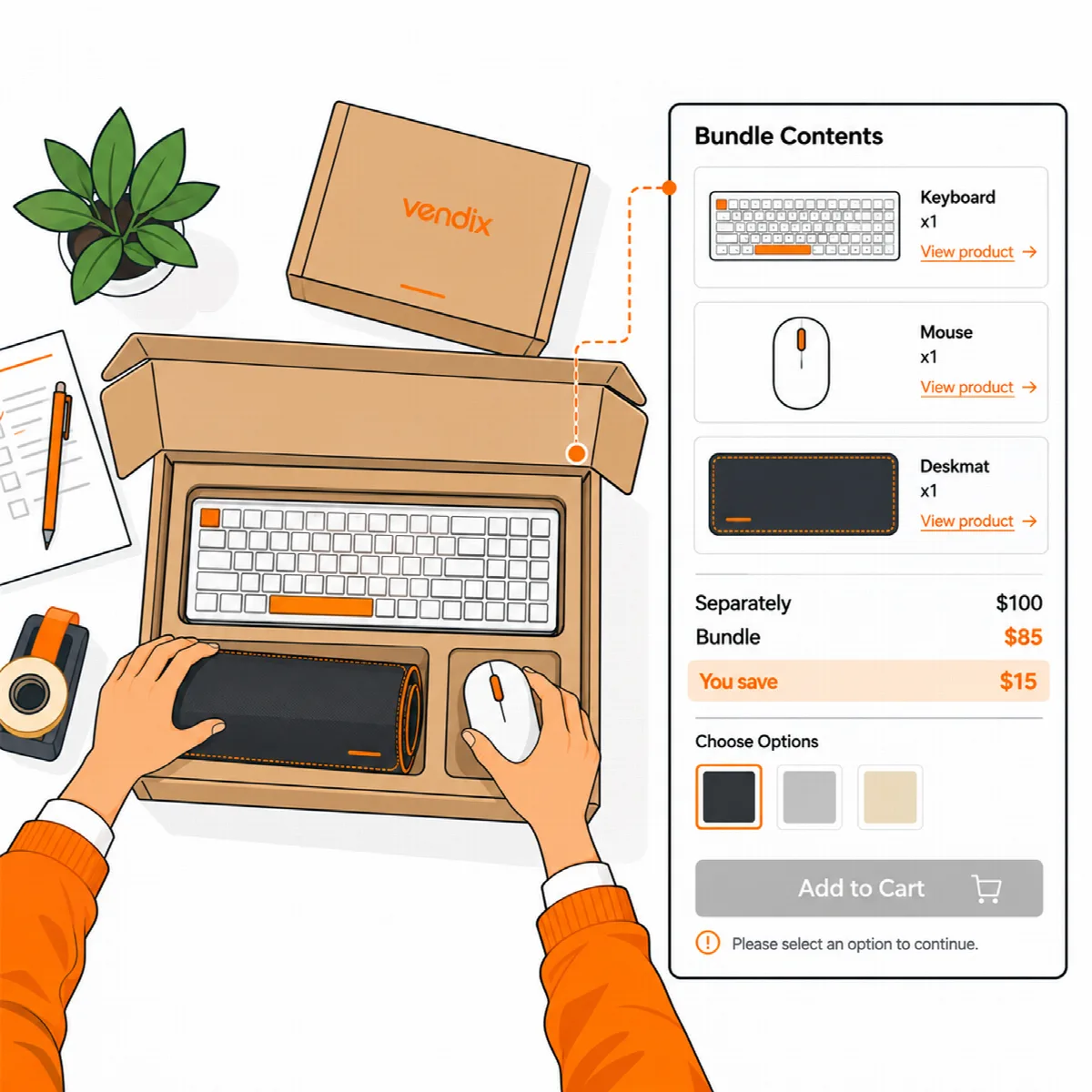
- Bundle page: each product appears with its image, quantity, name, its fixed or chosen variation and a "View product" link. The add to cart button stays off until every choice is made.
- Savings line: product pages and cards show "Separately: X · Bundle: Y · You save: Z (n%)", left out while the bundle does not cost less than its products.
- Stock: a bundle has no stock of its own. It can be sold while every product inside has enough stock. When WooCommerce reduces an order's stock, each product goes down by its bundle quantity; cancelled or failed orders bring the stock back. Bundles never take backorders.
- Cart and orders: the cart shows the bundle as one line with its products listed under it; the order screen, emails, account pages and invoices list them too.
- Coupons: coupons work on bundles unless the bundle turns them off on its Bundle contents tab, or Coupons do not apply to bundles anywhere on the site is on.
Bundles support the WooCommerce Cart and Checkout blocks and the WooCommerce order tables (HPOS).
Lead customers to bundles
Under Leading customers to bundles, three switches show bundles where they help:
- "This product is in these bundles" cards on the pages of products that are in a bundle, with the bundle price, the saving, "View bundle" and, when there is nothing to choose, "Add bundle to cart".
- "Complete the bundle" in the cart: when some products of a bundle are in the cart, the missing ones can be added at once.
- "Turn into the bundle" in the cart: when every product of a bundle is in the cart and the bundle costs less, one button replaces them with the bundle and shows the saving.
The cart never changes by itself: the customer chooses. If a step fails, the cart goes back to how it was.
Add quick buy buttons
Quick Buy Buttons offers up to five buttons:
| Button | What it does |
|---|---|
| Add to cart without reloading the page | Adds the product and updates the header cart at once |
| Buy now | Sends only this product or bundle to the checkout; the rest of the cart is kept aside and comes back after the order, or when the customer returns to the cart without paying |
| Ask on WhatsApp | Opens WhatsApp with a question about the product |
| Order on WhatsApp | Opens WhatsApp with the chosen options, quantity and price |
| Marketplace buttons | Links to the same product on other stores, such as Amazon, Trendyol or Noon; up to eight per product, each with its own text and optional logo |
- Make sure your WhatsApp number is filled in ARN Vendix → Company Data. The WhatsApp buttons stay hidden until a number is added.
- Open ARN Vendix → WooCommerce → Quick Buy Buttons and turn on Turn on the quick buy buttons.
- Tick the buttons every product shows by default.
- Optionally edit the message templates. They accept
{product},{variation},{quantity},{price}and{link}. - Optionally turn on Also on product cards in product lists: Buy now (for products without options) and Ask on WhatsApp.
- Save. Each product can show or hide each button on its own Quick Buy Buttons tab, where you also add its marketplace links.
Both WhatsApp buttons only open WhatsApp with a ready message; no order or other record is created in the store. Marketplace links need a full address that starts with https:// and carry rel="nofollow noopener".
Elementor widgets
While their module is on, three WooCommerce widgets appear in Elementor:
| Widget | What it shows |
|---|---|
| ARN Bundle Contents | The products of a bundle as a list, a grid or a carousel, with the savings line and the bundle's buttons |
| ARN Product in Bundles | Cards of the bundles a product is in |
| ARN Smart Product Buttons | The quick buy buttons of the current product or a chosen one |
On product pages built without Elementor, the same blocks are placed through WooCommerce hooks.
Discounts and product option plugins
- Discount Rules: Vendix bundles take no discount from Discount Rules, so a bundle keeps its own price and saving. Quantity tiers, "Buy X, pay for Y" and gifts are explained in WooCommerce discount rules, quantity discounts and order limits.
- Product option plugins (Vendix 3.0.0 and later): the option prices of PPOM for WooCommerce and ThemeHigh Extra Product Options are kept with bundles, gifts, Discount Rules, Order Limits, Cart Value and Quotes. "Complete the bundle" does not add a product that takes such options, and "Turn into the bundle" does not replace its cart line, so its options are not lost. The Buy now button of a product card sends such a product to its page, so the customer chooses the options first.